Jennifer here. I hope you've enjoyed our June journey through the clouds. The research we do on Writing Prompts, Thoughts and Ideas, Oh My! is fun and entertaining for us. We want you to reap the benefits from our investigations. Join us in July as we explore the holidays by the season. Now for our monthly contest...
When you hear the word contest, what do you think? Money, new car, fame, fortune? Sorry, this isn't that kind of contest. However, if you could spend a $10 Amazon gift card and bask in a smidgen of fame among your fellow writers, this contest is for you.
Begin your (under 500 words) short story with this month's cloud prompt below...
"A slight breeze tugged on the linen as Nonnie secured it to the clothes line. She glanced toward the western sky. A thin sheet of delicate, white lace, much like her grandmother's curtains, spread from the north to the south. However, that beautiful picture was not what caused her breath to hitch in her lungs . . .
Winner will be announced on next Tuesday's blog. That means you'll need to have your award-winning story to us by midnight Sunday (central time). Amaze and wow us and win, win, win. We look forward to seeing your story. Tell all your friends.
Showing posts with label Clouds. Show all posts
Friday, June 29, 2012
Friday, June 22, 2012
Cirrus Aviaticus - Contrails
| Author, Joe Thomissen |
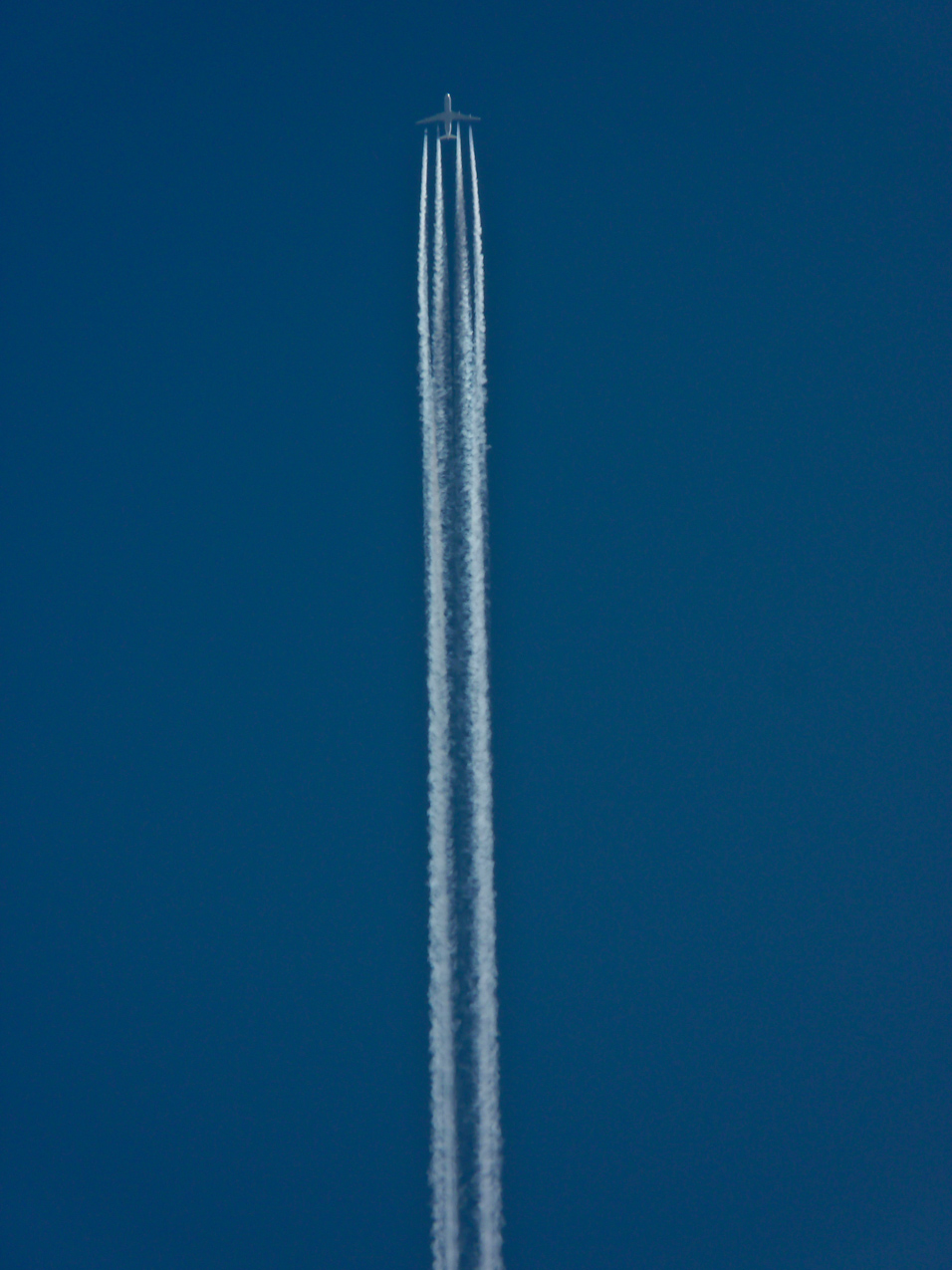
And now, an “artificial” cloud: Contrails
We used to call them jet trails. The thin lines across the brilliant, blue sky, evidence of the flight of an airliner. Sometimes you’ll see several, crisscrossing one another. I never really thought of these as being actual clouds. But they are.
How are contrails formed? Jet engines emit exhaust that contains water vapor. Above 26,000 feet where the temperature is usually below -40 °F, condensation occurs quickly. Ice crystals form and your vapor trail is created.
Contrails can also be triggered by changes in air pressure, (wingtip vortices) in lower altitudes, when the jets are traveling at slower rates of speed. They trail behind the wingtips and wing flaps rather than the engines.
Contrails have an opposite effect called Distrails, which looks like a tunnel through existing clouds. It is the path of the jet, as shown in the picture below.
I would like to note here that there is some concern about the longterm consequences of contrails and chemtrails. You can read more about this aspect at http://www.pbs.org/wgbh/nova/space/contrail-effect.html.
Research
Research
| Author, Brocken Inaglory |
Tuesday, June 19, 2012
The Veil
There are so many types of cloud formations that we could talk about them for weeks on end and we haven't even hit my favorites. Hopefully we'll do that next week. I'm hope you're seeing the formation of clouds depends on what part of the atmosphere they're in. They also depend on several other factors too. Like the cirrostratus. The cirrostratus are high based clouds "when convectively stable moist air cools to saturation at a high altitude" (http://en.wikipedia.org/wiki/List_of_cloud_types). Sometimes, websites say it best, especially when it comes to science.
The thing about cirrostratus clouds, and I'm sure you've noticed it yourself, is that they almost always take up the entire visual when they move in. Since I don't have a picture available, let me try to describe it to you. It's like a wave riding across the sky. Well, riding depends on how fast the cloud is moving. The reason it takes up so much space is usually because a frontal line is pushing it, so depending on how quickly that frontal line is moving depends on fast the cloud moves.
As the cloud gets closer, depending on the weight of precipitation, which depends on the temperatures and whether or not they're clashing with other fronts, the cloud formations can begin to look lower, heavier and darker. This frontal cloud can mean rain or snow. Here is a great link to a time lapse video http://youtu.be/gNGhvbjBVQw.
Here is another video.
The optical phenomena that you see is most likely from the cloud formations changing and dropping into the lower atmosphere. It seems to me that as the clouds thicken and more ice crystals form, the sun reflects off of them like a prism causing the beautiful spectacle.
The videos I shared are of a more dramatic nature of the cirrostatus and come along with other cloud formations. As I said above, much depends on the many other factors. However, there are times when the cirrostatus appears to be nothing more than a thin sheet of lace.
I love how dictionary.com describes the cirrostratus-- appearing as a whitish and usually somewhat fibrous veil.
Writing prompt: A slight breeze tugged on the linen as Nonnie secured it to the clothes line. She glanced toward the western sky. A thin sheet of delicate, white lace, much like her grandmother's curtains, spread from the north to the south. However, that beautiful picture was not what caused her breath to hitch in her lungs . . .
The thing about cirrostratus clouds, and I'm sure you've noticed it yourself, is that they almost always take up the entire visual when they move in. Since I don't have a picture available, let me try to describe it to you. It's like a wave riding across the sky. Well, riding depends on how fast the cloud is moving. The reason it takes up so much space is usually because a frontal line is pushing it, so depending on how quickly that frontal line is moving depends on fast the cloud moves.
As the cloud gets closer, depending on the weight of precipitation, which depends on the temperatures and whether or not they're clashing with other fronts, the cloud formations can begin to look lower, heavier and darker. This frontal cloud can mean rain or snow. Here is a great link to a time lapse video http://youtu.be/gNGhvbjBVQw.
Here is another video.
The optical phenomena that you see is most likely from the cloud formations changing and dropping into the lower atmosphere. It seems to me that as the clouds thicken and more ice crystals form, the sun reflects off of them like a prism causing the beautiful spectacle.
The videos I shared are of a more dramatic nature of the cirrostatus and come along with other cloud formations. As I said above, much depends on the many other factors. However, there are times when the cirrostatus appears to be nothing more than a thin sheet of lace.
I love how dictionary.com describes the cirrostratus-- appearing as a whitish and usually somewhat fibrous veil.
Writing prompt: A slight breeze tugged on the linen as Nonnie secured it to the clothes line. She glanced toward the western sky. A thin sheet of delicate, white lace, much like her grandmother's curtains, spread from the north to the south. However, that beautiful picture was not what caused her breath to hitch in her lungs . . .
Friday, June 15, 2012
“Mackerel” Clouds
In the past, my descriptions of clouds would be white, puffy, cottony, cotton candy—do you see a pattern here? What I’ve learned over the last few weeks is that there are all types of clouds and many are not so puffy.
Cirrocumulus are high altitude, cold weather clouds that contain snow or ice. They are actually tiny puff clouds, sometimes referred to as cloudlets. Often cirrocumulus clouds are called “mackerel” clouds because of their resemblance to the scales of a fish. Cirrocumulus clouds never cast self-shadows and are translucent to a certain degree. A cloud without a shadow? Interesting.
Cirrocumulus clouds tend to reflect the red and yellow colours during a sunset and sunrise, and thus they have been referred to as "one of the most beautiful clouds". This occurs because they reflect the unscattered rays of light from the early morning or evening sun, and those rays are yellow, orange, and red.
Today’s writing prompt:
Alan reached for Sue’s hand as he pointed toward the setting sun. “See the cirrocumulus clouds?”
Sue’s smile turned to a frown. “Yes. But what’s that coming through…
For more on these clouds and others, check out the following links:
Tuesday, June 12, 2012
Mare's Tails
My apologies for posting a tad late today. I've had a lot on my mind and let time pass me by.If you're a writer I'm sure you heard that you should never open a scene with weather. It's a rule I've been told over and over, especially with this particular scene from my Scottish historical. However, I believe this is one rule that can either be broken or adapted. Why? Because weather can serve to set the mood of the scene. It can be a foretelling of what is to come. On the other hand, it can be predictable.
Think about Little Red Riding Hood. You all know what happens, but let's say you didn't. Let's say Little Red's skipping along with basket in hand. Instead of a dark forest we have open skies. Are they blue with wispy clouds or dark and foreboding? If the clouds are light and fluffy you'd expect something good to happen, not a big bad wolf at the end of the trail. If they are dark and monstrous you wouldn't be surprised at the snarling wolf. However, because we all know the story, we pretty much know what to expect no matter what the clouds might look like.
I've often heard that cirrus clouds, also known as mare's tails, are a sign of a change in weather. Most likely it's a sign of rain to come. But you could use these wispy high altitude clouds as a change to come in your character's life.
Today's writing prompt:
If the mare's tails dancing across the blue sky were any indication . . .
Think about Little Red Riding Hood. You all know what happens, but let's say you didn't. Let's say Little Red's skipping along with basket in hand. Instead of a dark forest we have open skies. Are they blue with wispy clouds or dark and foreboding? If the clouds are light and fluffy you'd expect something good to happen, not a big bad wolf at the end of the trail. If they are dark and monstrous you wouldn't be surprised at the snarling wolf. However, because we all know the story, we pretty much know what to expect no matter what the clouds might look like.
I've often heard that cirrus clouds, also known as mare's tails, are a sign of a change in weather. Most likely it's a sign of rain to come. But you could use these wispy high altitude clouds as a change to come in your character's life.
Today's writing prompt:
If the mare's tails dancing across the blue sky were any indication . . .
Friday, June 8, 2012
Nacreous Clouds
Also called: Mother-of-Pearl Clouds, Wave Clouds, or Polar Stratospheric Clouds (PSCs)
A southern girl like me has only seen these clouds in photographs. But the photos are breathtaking. They look like iridescent sheets, undulating with the winds and waves of the atmosphere.
They hang out in the lower stratosphere, 9 - 16 miles high and can be seen in winter, just after sunset and just before dawn. These clouds consist of ice crystals that are uniform in shape and size. The unusual colors result when the sun’s rays hit the thin clouds at just the right angle.
These are regarded as “dangerous beauties” by scientist who believe they are helping destroy the ozone layer. In August 2006, an unusual cloud formation was spotted over Australian Mawson Station in Antartica (see inset NASA photo). It was believed that this unusual sighting was caused by extreme weather conditions.
In January 2008, nacreous clouds put on a gorgeous month-long display in Scandinavia (you can read about it in detail and see some amazing photos on this page).
Whatever your genre, these mysterious and beautiful cloud formations could add depth and color to your composition.
Research:
Subscribe to:
Posts (Atom)